

A water softener system is built to deal with hardness, not to clean every substance out of your water. Hardness is dissolved calcium and magnesium. In an Austin home, those minerals show up as spots on glass, a film on fixtures, and scale inside a water heater. If you want to know how a water softener system works in Austin, start with that job. A salt-based softener trades those minerals for sodium or potassium. A salt-free unit does not make that trade.
Contact Mend Services to match a water softener system to your home.
How a water softener system works in Austin homes
A salt-based softener uses cation exchange. Incoming water passes through a tank of resin beads. Those beads hold sodium or potassium ions. Calcium and magnesium ions in the water stick to the resin more strongly, so they swap places. The water that leaves the tank has far less of those hardness minerals. The U.S. Environmental Protection Agency describes this exchange, and the regeneration cycle that follows, in its WaterSense technical sheet on water softeners.
Most whole-home units have three working parts. The mineral tank holds the resin. The control valve decides when water flows through the resin and when the system cleans itself. The brine tank holds salt and water. That salt water is what recharges the resin after the beads fill up with calcium and magnesium.
Regeneration is the reset. The valve sends brine through the resin. Sodium or potassium ions push the hardness minerals off the beads. The system then rinses that mineral-heavy water to the drain. After the cycle, the resin is ready to soften again. Demand-initiated systems start this cycle when the resin is actually used up. A timer system runs on a set schedule, even if the household used little water that day. EPA notes that demand-initiated units use less water and salt than fixed-schedule units.
Hardness is measured as calcium carbonate. The U.S. Geological Survey classifies water by that measure. Water under 60 milligrams per liter is soft. Water from 61 to 120 is moderately hard. Water from 121 to 180 is hard, and anything above 180 is very hard. You can read the full scale on the USGS hardness of water page. A test at your own taps matters more than a citywide average, because source water and home plumbing both change what you see.
Salt efficiency is the other number worth knowing. It is the grains of hardness removed per pound of salt. A more efficient setting uses less salt and sends less sodium and chloride to the drain. NSF/ANSI 44 is a voluntary standard for residential cation-exchange softeners. Its efficiency rating calls for 5.0 gallons of water or less per 1,000 grains of hardness removed. A certification mark is useful, but it does not replace a hardness test or a look at the space you have.
What the resin, valve, and brine tank each do
The resin is a bed of small plastic beads with a charge that attracts positive mineral ions. Fresh beads are loaded with sodium or potassium. As hard water passes through, calcium and magnesium take those spots. Nothing is filtered out in the sense of a screen catching sand. The minerals are swapped, then held on the beads until regeneration.
The control valve is the traffic director. In service mode, it sends untreated water down through the resin and out to the house. In regeneration, it closes that path and opens a path from the brine tank. A metered valve counts gallons. When the count reaches the set capacity, it queues a recharge, often at a low-use hour so you are not waiting on hot water during the cycle.
The brine tank is the salt reservoir, not the treatment tank. Salt dissolves in a small pool of water to make brine. During recharge, that brine is drawn into the resin tank. After the hardness minerals are pushed off, a rinse flushes the brine and the minerals to a drain. If the drain line is kinked, or the air check in the brine well is stuck, the recharge can fail even when the tank looks full of salt.
Capacity is the amount of hardness the resin can hold between recharges. It is usually stated in grains. A larger family, harder water, or more laundry and showers will use that capacity faster. Sizing is the installer’s job, and Mend covers visit steps separately. What you need to know here is that an undersized resin bed regenerates often. And an oversized one can sit idle and waste salt if the settings are lazy.
Potassium chloride can replace sodium chloride in many brine tanks. The exchange still works. The difference is which ion goes into the treated water and which salt you buy. Potassium costs more and can feel different in the brine tank, so confirm the valve and the manual allow it before you switch. People who watch sodium in drinking water often pair a softener with a small kitchen reverse osmosis tap rather than leaving the whole house untreated.
How Austin plumbing changes the picture
The science of ion exchange is the same in every city. The plumbing around it is not. Many Austin homes have the water heater, softener, and main shutoff in a garage or a closet, with a floor drain nearby. Others have a slab-foundation utility corner with little extra width. A salt-based system needs the resin tank, the brine tank, a drain, and power for the valve. A salt-free unit is often smaller. But it still needs a place on the main line and a bypass so the house can get water while the media is serviced.
Hot water is where scale shows up first, because calcium carbonate drops out as water is heated. That is why a water heater can collect a hard layer even when cold taps only show spots. A softener placed before the heater treats the water the heater stores. A unit placed only on a kitchen line does not protect the heater, the showers, or the laundry. Whole-home means the main indoor branch, not every outdoor bib.
Austin’s published water quality reports describe the utility supply. Not the hardness at your hose bib after a private well tie-in, a remodel, or a long run of old pipe. Use the city report as background. Use a test at your home for the decision. If you are on a well, hardness and iron can both be higher, and iron can foul resin. Say so before anyone recommends a bead type.
Mend’s Austin water softener page says municipal water in the area often tests around 10 to 15 grains per gallon. That is a local service statement, not a promise that your house matches it. Ten grains is already in the hard range on common scales. Fifteen is higher. The right response is still a test, then a choice between removing the minerals or only conditioning them.
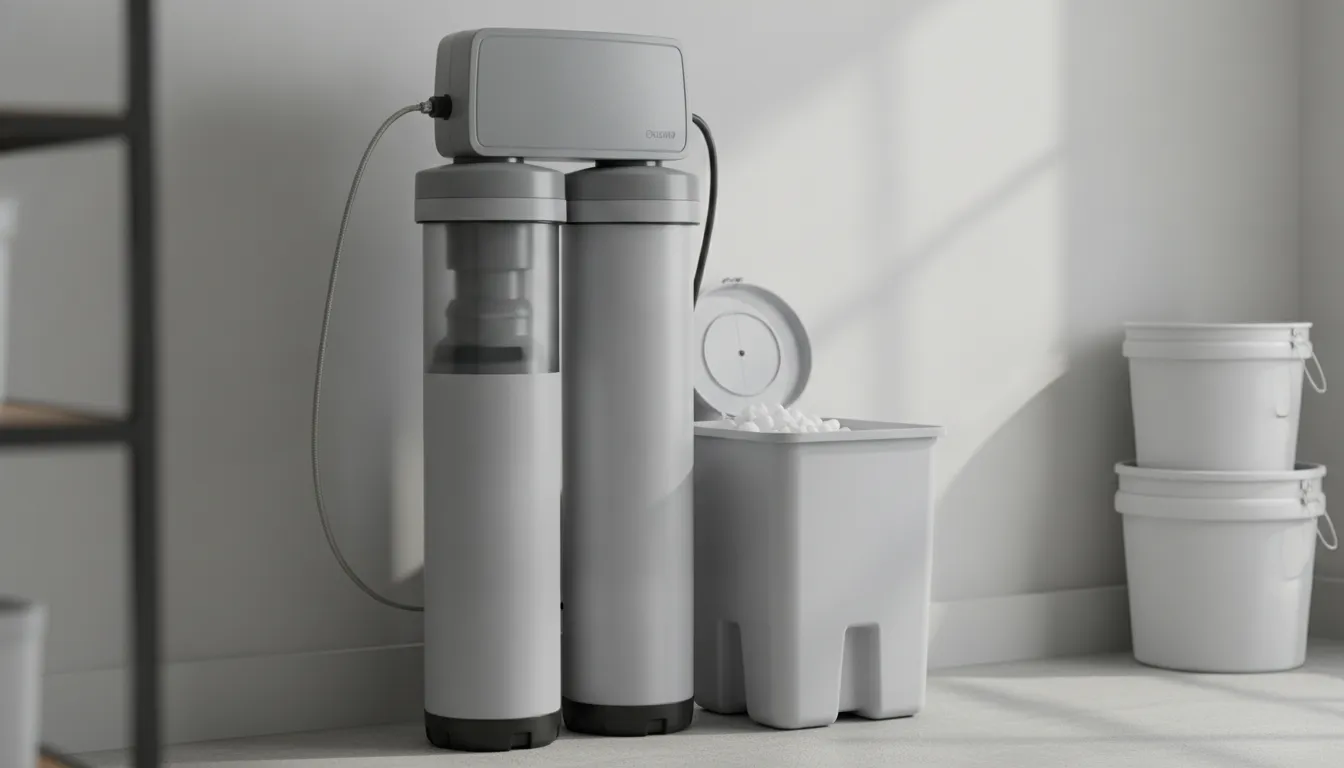
While you wait on that test, you can still learn the layout. Find the main shutoff, the water heater, and the nearest drain. Note whether a garage or closet has a standard outlet for a valve. Those facts do not choose salt versus salt-free, but they tell you whether a brine tank will fit. If you want a licensed plumber to measure and explain the options, Mend’s plumbing team can do that on a scheduled visit.
What salt-free equipment does instead
Salt-free equipment is often sold as a softener, but it does a different job. University of Nebraska Extension describes these units as descalant devices. They do not pull calcium and magnesium out of the water. They try to change how those minerals behave so scale is less likely to stick to pipes and heaters. If your goal is water that no longer holds those minerals, a salt-free unit will not do that.
That difference shows up in daily use. A true softener can reduce the film that makes soap hard to rinse and the spots that dry onto glass. A conditioner may help with scale on heating surfaces and still leave the minerals in the water. Taste, odor, sediment, and specific contaminants are a separate question. Those usually call for a filter or reverse osmosis, not a softener. Mend’s water filtration system installation page covers that path.
Neither device is automatic for every house. EPA says softeners should be considered where hardness is substantial, or where an appliance maker, code, or water utility recommends one. Some areas limit softeners to cut salt and water waste. Austin homeowners still need a test and a look at the plumbing before they pick a type.
| Question | Salt-based softener | Salt-free conditioner |
|---|---|---|
| Does it remove calcium and magnesium? | Yes. Ion exchange swaps them for sodium or potassium. | No. The minerals stay in the water. |
| What does it mainly change? | Hardness of the treated water. | How minerals form scale on surfaces. |
| What do you add? | Salt or potassium chloride, plus periodic checks. | Usually no salt. Media still needs service on its own schedule. |
| Where does the waste go? | Regeneration sends mineral-rich water to a drain. | There is typically no brine discharge. |
| When is it a poor fit? | If you need to avoid added sodium, or you have no drain and space for a brine tank. | If you want the minerals removed, not only managed as scale. |
Questions that point you to the right type
Use the comparison as a filter, then answer a few questions about your own house. The answers do not size a system. They tell you which conversation to have.
- Do you want the hardness minerals gone, or do you mainly want less scale on heaters and fixtures?
- Is there a drain, a level floor, and room for both a resin tank and a brine tank near the main line?
- Does anyone in the home need to limit sodium from drinking water? A kitchen reverse osmosis tap, or potassium chloride instead of sodium chloride, is a separate choice.
- Are spots, soap feel, and scale the only issues, or do you also notice taste, odor, or sediment?
- Will you keep salt in the brine tank, or do you want a unit that does not need that refill?
A whole-home softener treats water after the main shutoff and before most fixtures. Outdoor hose bibs are often left on untreated water so you do not spend salt on irrigation. That bypass is a plumbing decision, not a feature of the resin itself. If the main line, drain, or electrical outlet for the valve is hard to reach, say so early. The equipment type can be right and the location still wrong.
Mend Services tests hardness before recommending a system, then sizes a whole-home softener to the household’s water use. The company is a locally owned Austin plumbing, electrical, and HVAC contractor, and its plumbing work is done under master plumber license M-46376. You can see the service scope on the Austin water softener services page. For signs around the house and the broader treatment menu, read Austin hard water signs and treatment options.
Care that keeps the exchange working
A softener only keeps working if the resin can recharge. Check the brine tank on a schedule you will actually keep. The salt level should stay above the water line. Use the salt type the manufacturer calls for. Bridged or mushy salt can leave the resin without a clean recharge, and the water downstream starts to act hard again.
Also look at the valve settings once the unit is in service. A demand-initiated control needs an accurate hardness number and a realistic household size. A setting that is far too low can exhaust the resin between cycles. A setting that is far too high wastes salt and water. If the display shows an error, or regeneration runs much more often than it used to, stop guessing and have the valve checked.
Salt-free media has its own service life. It does not need a salt refill, but it is not maintenance-free. Ask what the media is, how long the maker rates it, and what a replacement visit includes. Put that next to the salt and water a cation-exchange unit will use. The cheaper box is not always the cheaper system over ten years. Mend notes that many softeners last about that long with normal care.
This guide stops at how the equipment works and how the two types differ. It does not price a job or diagnose a failed unit. If you are planning the visit itself, read what to expect from water softener installation in Austin. If a system you already own has changed, use water softener repair signs in Austin. For the wider plumbing team behind that work, start at Mend plumbing services.
Contact Mend Services when you are ready to compare water softener systems.
FAQs
Does a water softener make Austin water safe to drink?
No. A softener is not a purifier. It reduces calcium and magnesium through ion exchange. It does not, by itself, remove chemicals, microbes, or sediment. If drinking-water quality is the concern, ask about a filter or reverse osmosis in addition to, or instead of, a softener.
Will a salt-free system stop spots on glass?
Not in the same way a softener does. A conditioner leaves calcium and magnesium in the water and aims to reduce scale. Spots can still dry onto glass because the minerals are still there. A salt-based softener is the type that actually removes those minerals from the treated water.
How often does a softener need salt?
There is no single interval. It depends on hardness, how much water the home uses, the resin capacity, and the salt setting. Check the brine tank regularly and refill before the salt drops to the water line. A demand-initiated valve uses salt when the resin is spent, not on a clock.
Can I soften only part of the house?
Yes. Many homes soften the indoor cold and hot lines and leave outdoor bibs on untreated water. A kitchen drinking-water tap can also stay separate if someone wants to limit sodium. Those choices are made in the plumbing layout, so bring them up before equipment is selected.
Who services water softeners in Austin?
Mend Services installs, repairs, and maintains water softeners for Austin-area homes, and tests hardness before sizing a system. Call (512) 360-0704 or schedule a visit when you want a licensed plumber to walk through the options.


