

.
When a Kyle home stops cooling, the safest first move is to observe the symptoms instead of opening the equipment. Warm rooms, weak airflow, unusual sounds, water near the indoor unit, or a system that will not start can have different causes. A careful visual check gives a qualified technician useful information without creating an electrical, refrigerant, or water hazard.
This guide focuses on AC repair in Kyle TX. It explains safe homeowner checks and urgent warning signs. It also covers repair versus replacement questions and what to gather before a service visit. For broader Austin HVAC repair, installation, and maintenance services, Mend Services also supports homeowners across Greater Austin.
What Should You Do First When Your AC Stops Cooling?
When an air conditioner stops cooling, begin with a controlled symptom check. Confirm the thermostat mode, notice whether air is moving, inspect the filter without opening the equipment cabinet, and look for water or ice. If you smell burning, see sparks, or find water near electrical equipment, stop troubleshooting and request professional help.
Start at the thermostat. Confirm that it is set to cooling, the target temperature is below the current room temperature, and the fan is not set to run continuously. Give the system a short opportunity to respond, then check several supply vents. Note whether air is moving and whether it feels cooler than the room. Uneven cooling can point to airflow, duct, thermostat, or equipment concerns, but the symptom alone does not identify the failed part.
Next, look at the filter if it can be accessed without tools. A visibly dirty filter can reduce airflow and put additional strain on the system. Replace a disposable filter with the correct size, or clean a reusable filter according to its instructions. ENERGY STAR’s air conditioner maintenance checklist also emphasizes regular attention to filters, coils, and airflow.
Walk outside and look at the condenser from a safe distance. Remove loose leaves and debris around the unit, but do not remove the cabinet. Do not spray electrical components or attempt to straighten fins unless a trained professional has directed you. Inside, look for standing water, an active drip, or ice on accessible lines. Do not touch suspected refrigerant leaks or try to add refrigerant.
Write down what you find: when the issue started, which rooms are affected, the thermostat setting, sounds, odors, water, ice, and recent repairs. This information gives the technician a useful starting point. It also keeps a homeowner’s safe visual check separate from work that requires testing equipment and trade expertise.
Common AC Problems in Kyle-Area Homes
Common cooling complaints include warm air, weak airflow, short cycling, unusual noise, water around the indoor unit, and a condenser that will not start. Each complaint has multiple possible causes. A restricted filter, blocked return, thermostat issue, condensate problem, electrical failure, refrigerant concern, or worn component may produce overlapping symptoms, so professional testing is important.
Warm air or a system that runs continuously
If the system runs but the home remains warm, check the thermostat and filter first. Then note whether the outdoor condenser starts and whether airflow is weak at the vents. Continuous operation can result from restricted airflow, a dirty coil, a refrigerant problem, an undersized or poorly distributed system, or a component that is no longer operating correctly. Do not remove access panels to investigate.
Weak airflow and uneven rooms
Weak airflow may be related to a loaded filter, blocked return, closed register, duct restriction, blower concern, or frozen coil. Make sure supply registers are open and furniture is not covering return grilles. If the indoor coil is visibly iced or the airflow continues to decline, turn the system off and schedule service. Running an iced system can make the underlying problem harder to diagnose and may increase damage.
Water, humidity, or a clogged drain
Air conditioning removes heat and moisture from indoor air. Water near the air handler, a full drain pan, or a sudden rise in humidity can indicate a condensate drainage problem, although the exact cause requires inspection. Keep people away from standing water near electrical equipment. Move belongings only if it is safe, and do not restart the unit repeatedly to see whether the drip stops.
Noise, odors, and repeated breaker trips
Clicking, buzzing, grinding, rattling, or hissing should be described rather than diagnosed remotely. A burning odor, smoke, sparks, exposed wiring, or a breaker that trips again after one reset requires immediate caution. Do not bypass a safety control, open the electrical compartment, or keep resetting the breaker. A qualified HVAC professional can determine whether the concern involves the thermostat, motor, capacitor, wiring, fan, compressor, or another component.
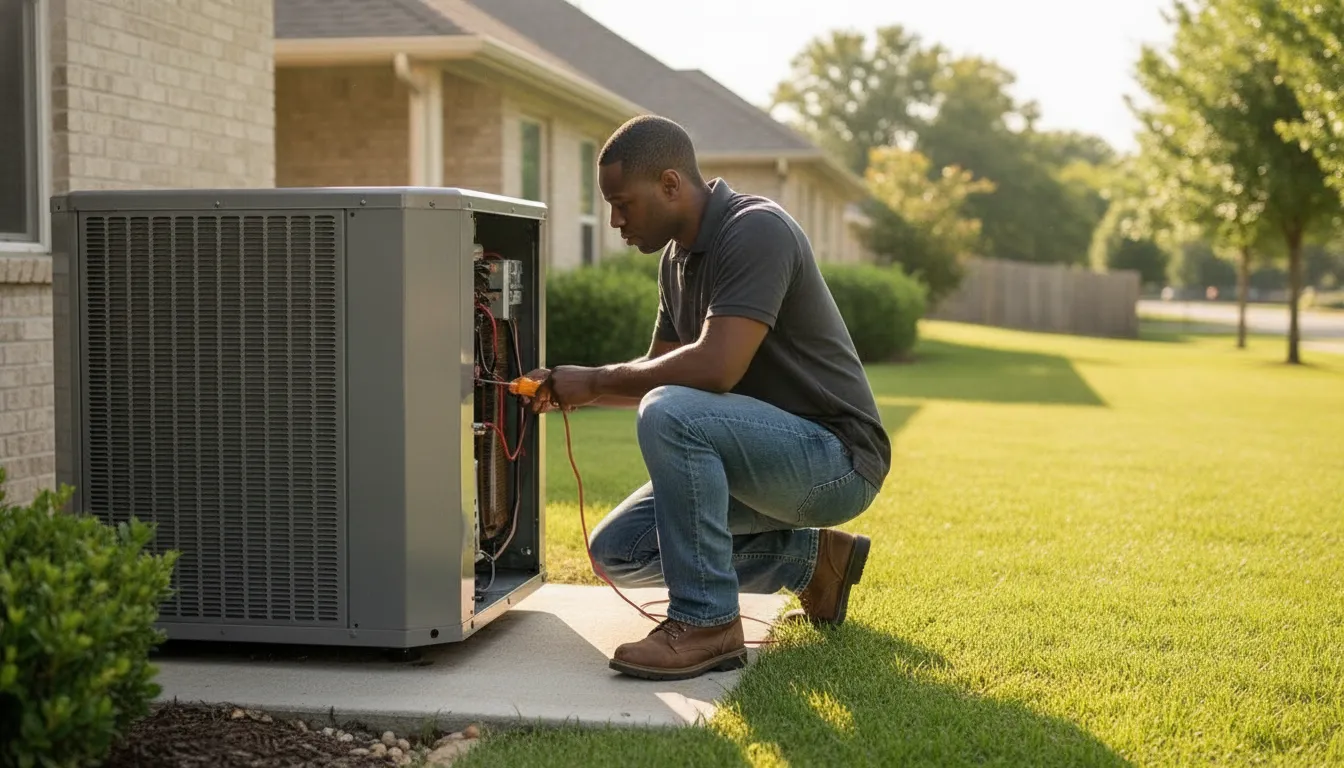
For homeowners who need a local starting point, Mend Services provides licensed AC repair and HVAC services for Kyle and surrounding Central Texas communities. Share the symptoms and recent service history when booking so the technician can prepare for a focused evaluation. Learn more about the company’s local team and service approach on the Mend Services About page.
When Is AC Repair an Emergency in Kyle TX?
AC trouble deserves urgent attention when it creates a safety risk, threatens significant water damage, or leaves vulnerable people without cooling during dangerous heat. Smoke, sparks, a burning smell, exposed wiring, water reaching electrical equipment, or a rapidly spreading leak are reasons to stop troubleshooting. Total cooling loss can also become urgent when infants, older adults, or people with health conditions are in the home.
Use this sequence while arranging help:
- Move away from immediate hazards. If you see smoke, sparks, or signs of fire, stay clear of the equipment. Leave the home and contact emergency services if anyone is in danger or there is an active fire.
- Turn the system off only if it is safe. Use the thermostat when possible. Do not reach across standing water, touch wet electrical equipment, or open a panel to find a switch. If the safest choice is to leave the system alone, wait for a qualified professional.
- Protect the area from water. Move belongings away from a leak only when you can do so safely. Place a container under an accessible drip if it does not require contact with electrical equipment. Do not restart the system to test the leak.
- Protect people, not just equipment. Move vulnerable occupants to a cooler, safe location if the home is becoming dangerously hot. Fans can improve comfort temporarily, but they are not a substitute for safe cooling in extreme conditions.
- Describe the urgency clearly. Tell the service team whether the system is completely down, whether smoke, sparks, burning odors, ice, or water is present, and what you have already switched off. Mend Services offers 24/7 emergency AC repair for urgent cooling failures.
Refrigerant handling, electrical repair, compressor testing, and internal component replacement are not homeowner troubleshooting steps. A clear account of the conditions helps the technician understand the risk before arriving and helps the household avoid an unsafe experiment.
Should You Repair or Replace an AC System?
The repair-versus-replacement decision should follow testing, not a single symptom or an automatic age rule. Ask what failed, whether the rest of the system is operating safely, whether the repair addresses the cause, and what condition the work is expected to restore. Consider repair history, comfort, airflow, refrigerant, safety, and equipment condition together.
An older system may still be a reasonable repair candidate when the failure is isolated and the equipment is otherwise dependable. A newer system may still need a substantial repair after a single component failure. Ask the technician to separate confirmed findings from items that need additional testing. The goal is to understand the available paths, not to choose based on a generic rule.
| Decision factor | Questions about repair | Questions about replacement |
|---|---|---|
| Failure pattern | Is this an isolated issue, and has the same component failed before? | Are repeated failures making future operation unpredictable? |
| Comfort | Can the repair restore dependable cooling and acceptable airflow throughout the home? | Would the current design or condition continue to leave rooms uncomfortable? |
| Refrigerant | What refrigerant does the system use, and has the cause of any leak been identified? | Would a new system better match the home’s cooling needs and future service requirements? |
| Safety | Will the repair address electrical, drainage, or mechanical risks rather than only the visible symptom? | Would replacement resolve a condition that is no longer practical to maintain safely? |
| Long-term fit | What service life and operating condition should a homeowner reasonably expect after repair? | What installation, maintenance, and comfort considerations should be evaluated before approval? |
Refrigerant type is one part of the conversation. The EPA explains in its guidance on purchasing and repairing home air conditioners that a pre-2010 system using HCFC-22 is not automatically required to be replaced solely because of that refrigerant. A professional evaluation can account for the equipment’s condition and the repair that is actually needed.
Ask for the diagnosis in plain language, the immediate scope of work, and the condition the repair should restore. Mend Services provides a one-year parts-and-labor warranty on services. Its trade leadership includes Texas licenses TECL #35517, M-46376, and TACLB29665E, which gives homeowners concrete credentials to discuss during a service decision.
How Can You Prepare for AC Repair in Kyle TX?
Preparation makes the service visit more efficient and gives a technician better evidence to work from. Record when the problem began and whether it happens continuously or only during the hottest part of the day. Note if the unit runs without lowering the temperature, cycles on and off too often, or stops working altogether.
Gather the thermostat mode, set point, current temperature if available, and rooms affected. Describe any buzzing, clicking, grinding, rattling, hissing, or burning odor. If you see water, ice, or a breaker issue, record where it occurred and whether it is still active. Do not open electrical panels or handle refrigerant to gather more information.
Information to have ready
- The main symptom and the time it started.
- Rooms with weak airflow or uneven temperatures.
- Thermostat mode, setting, and displayed temperature.
- Sounds, odors, moisture, ice, or visible equipment changes.
- Date of the most recent filter change or service visit.
- Approximate system age, manufacturer, and model if readily visible.
- Access instructions, pets, parking details, and gate information.
Questions to ask during the visit
Ask what the technician tested, what failed, and whether the recommendation addresses the underlying condition. Ask whether the repair should restore cooling, airflow, drainage, or safe electrical operation, depending on the diagnosis. If replacement is suggested, ask what evidence supports it and whether repair remains a reasonable alternative. You can also ask what maintenance would help protect comfort after the immediate issue is resolved.
Clear access helps the team work safely. Keep stored items away from the indoor equipment and ensure the outdoor condenser can be reached without stepping through hazards. If the air handler is in an attic or another restricted area, share that information when you schedule. For related local service information, see Mend’s Kyle home service options.
Why Choose Mend Services for AC Repair in Kyle?
Kyle homeowners often need a service provider that can respond to urgent cooling problems while explaining the work in practical terms. Mend Services is a locally owned, family-run home services company serving Greater Austin communities, including Kyle. Its HVAC service is part of a broader plumbing, electrical, and HVAC operation, so homeowners can keep one trusted contact for related home-system needs.
Mend’s HVAC license is TACLB29665E. The company uses full-time W-2 technicians rather than subcontractors and supports background checks and ongoing training. That employment model is a meaningful distinction for homeowners who want to know who is arriving, who is responsible for the work, and how service standards are maintained.
Mend Services also offers 24/7 emergency response for urgent service needs and backs services with a one-year parts-and-labor warranty. These policies do not replace a diagnosis, but they give homeowners useful questions to ask about response, scope, and post-service support. Before approving work, confirm the findings, the recommended next step, and what the warranty covers for the proposed repair.
Schedule a Kyle AC repair evaluation with Mend Services and get a clear next step for your home.
Frequently Asked Questions
Why is my AC running but not cooling my Kyle home?
Check the thermostat setting, filter, supply airflow, and outdoor debris without opening the equipment cabinet. Warm air can result from restricted airflow, a thermostat issue, a condensate problem, refrigerant concern, or a failed component. If the system continues running without cooling, schedule a qualified diagnostic rather than handling electrical or refrigerant parts.
What can I safely check before calling for AC repair?
Confirm the thermostat is calling for cooling. Replace a visibly dirty filter with the correct size, make sure registers are open, and remove loose debris around the outdoor condenser. Look for water or ice from a safe position. Do not open panels, touch wiring, add refrigerant, or keep resetting a tripped breaker.
When is a cooling problem an AC emergency?
Seek urgent help for smoke, sparks, burning odors, exposed wiring, water reaching electrical equipment, a rapidly spreading leak, or dangerous heat affecting vulnerable occupants. Turn the system off only when you can do so safely. Leave an active fire or immediate danger and contact emergency services.
Does an older AC system always need replacement?
No. System age is context, not an automatic verdict. Ask a qualified technician to consider the failure, repair history, comfort, airflow, refrigerant, safety, and overall condition. EPA guidance also states that a pre-2010 HCFC-22 system is not automatically required to be replaced solely because it uses that refrigerant.
What information should I give an HVAC technician?
Share when the issue began, the rooms affected, thermostat settings, airflow changes, sounds, odors, water or ice, recent filter changes, and prior service. Mention whether the outdoor unit runs and whether a breaker has tripped. These details help the technician plan a focused inspection without relying on an unsafe homeowner diagnosis.


